Moto X3M turns motorcycle racing into a fast physics puzzle, where every jump tests your timing and balance. The track throws ramps, traps, and sudden drops at you without slowing down. One poor landing can end a perfect run.
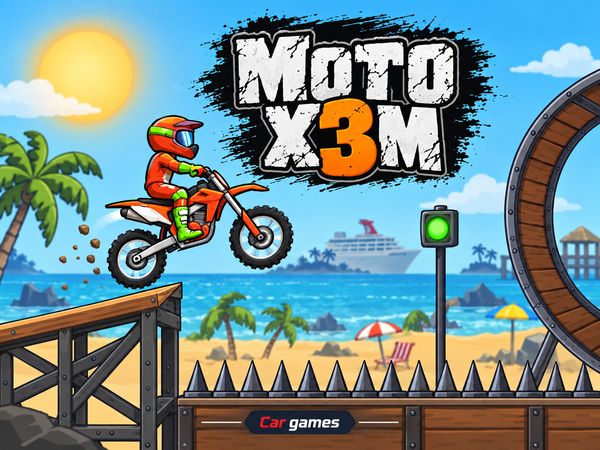
MadPuffers built this racing platformer around movement, control, and repeated attempts. You will learn each obstacle by riding through it, crashing, and trying a cleaner approach. Green traffic lights also save progress, so one mistake does not always send you back to the start.
Use the keyboard controls, study each course, and chase a better finish time.Start with control, then add speed.
Mastering Moto X3M Stunts and Scoring
Achieving a Three-Star Rating
A three-star rating demands more than reaching the finish. Moto X3M records your total time, then uses your performance to award stars. Fast riding helps, but reckless speed creates crashes that damage the run. Treat every jump as part of the final score.
Begin by completing the course safely. Your first attempt should reveal the track’s rhythm, not chase a perfect result. Notice where ramps launch the bike, where platforms collapse, and where hazards interrupt the route. Once you know those points, you can replace guesses with planned actions.
Clean movement saves more time than constant acceleration. Hold Arrow Up across open ground, then release it before a tight landing. Use Arrow Down when the bike carries too much speed toward a short platform. A controlled approach often beats a desperate correction after the jump has already started.
Watch your pitch during every stunt. Arrow Left controls the back wheel, while Arrow Right controls the front wheel. Small taps help the bike match a ramp or return to a level position. Long presses can rotate the bike too far, especially when the motorcycle leaves a steep launch.
Replay the same course after each successful finish. Focus on one weak section at a time. Improve the opening jump first, then the next hazard, rather than changing your entire route at once. This method builds a reliable run and reduces the crashes that add unwanted time.
Stars also give each finish a clear goal. A completed level proves that your route works. A higher rating shows that your timing became sharper. Keep the bike stable, preserve momentum where the track allows it, and brake before speed turns into a liability.
Navigating Hazards and Checkpoints
Common Obstacles and Traps
Moto X3M fills its tracks with hazards that punish careless speed. Giant circular saws cover narrow passages and force precise movement. Explosive TNT crates end a run when you hit them, so approach their section with control rather than blind acceleration.
Collapsing platforms change the timing beneath your wheels. Ride across them quickly, but keep enough balance for the next landing. Moving hammers demand patience because their safe gap shifts from moment to moment. Spikes create a similar test, especially when a jump gives you little room to correct the bike.
Do not treat every obstacle as a race. Some sections reward a short brake before the danger. Others require steady momentum through a gap. Watch the shape of the track, identify the next landing zone, and choose your speed before the bike reaches the hazard.
Crashes happen often during early attempts. The instant restart system gets you back into the action quickly, while checkpoints protect earlier progress. Use each failed run as a timing lesson. The goal is not merely to survive one trap, but to understand the sequence around it.
Utilizing Traffic Light Checkpoints
Green traffic lights mark the game’s checkpoints. Ride past one, and the game saves your progress at that point. If the rider crashes or falls into a trap, the next attempt begins from the last activated light instead of the level’s opening.
Use that protection to practice difficult sections. After respawning, focus only on the obstacle ahead. Test a slower entry, then try a faster line once the landing feels safe. Checkpoints turn complex track segments into smaller practice goals.
Physics-Based Bike Control
Managing Momentum and Pitch
Your motorcycle’s pitch controls nearly every jump. Arrow Left moves the back wheel, while Arrow Right moves the front wheel. Tap either direction to adjust the bike in the air. Keep the frame level when a flat landing waits below, but angle the wheels when the track rises or falls sharply.
Throttle management matters just as much. Arrow Up accelerates, and Arrow Down brakes. Hold acceleration across a long launch when the bike needs distance. Release it before a tight landing, or tap the brake when your current speed would carry you beyond the safe surface.
Loops and steep ramps demand different choices. A loop needs enough momentum to carry the bike around its curve. A steep drop may need braking before the descent begins. Learn to read the next landing rather than reacting after the front wheel reaches it.
Leaning back helps the bike climb a steep obstacle. Leaning forward steadies the motorcycle during a fast descent. Neither position works everywhere. Shift the pitch in small movements, and return toward level before the wheels touch down.
Think of each jump as a short sequence: build speed, launch, correct pitch, then settle the landing. That rhythm keeps the controls simple. Once the sequence becomes familiar, you can attack the course faster without losing control.
Landing and Stability
Safe landings begin before the wheels reach the ground. Match the bike’s angle to the surface below. A level platform needs a level bike, while a sloped ramp rewards a matching angle.
A forward or backward lean that remains too extreme causes a crash. Use brief Arrow Left or Arrow Right taps to correct the frame. Brake when speed threatens to carry you past the landing zone, then accelerate again after the wheels settle.
Stability also protects your next move. A clean landing keeps the bike ready for the following ramp, hammer, or gap. Avoid dramatic corrections at the last moment.
Ready for another run? Start playing Moto X3M here and turn each crash into a better line.
Moto X3M Series History and Versions
Original Release and HTML5 Transition
MadPuffers created Moto X3M as a racing and platformer game built around stunt riding. Its challenge came from tight level design, quick restarts, and physics that made every jump feel physical.
The game gained attention across gaming portals because its tracks encouraged repeated attempts. Players could finish a course, notice a weak section, and immediately test a better approach. That loop helped the title stand out from simpler racing games.
Moto X3M later moved from Flash technology to HTML5. The transition kept the central experience focused on motorcycle control, hazards, checkpoints, and stunt racing.
Its identity remains clear in the title. “X3M” uses leetspeak for “Extreme,” which matches the game’s sharp jumps and dangerous track design. MadPuffers also developed the broader formula around unlockable bikes and riders, adding variety to the stunt-racing theme.
How a Run Ends and Win Conditions
Winning the Level
A run ends successfully when the rider crosses the finish line. The endpoint usually uses a checkered flag or a clear end-zone. Reach it, and the game displays your total time along with the stars earned for that performance.
Use the finish screen to judge the whole attempt. A safe completion gives you a result to beat. If the route felt slow, replay the course and adjust the sections that caused hesitation. You can also move forward when the result satisfies you.
Fast finishes depend on consistency, not reckless inputs. Keep momentum through open stretches, then brake before a dangerous landing. Correct the bike early, because late steering often creates another crash. Every clean section protects the time earned before it.
The best runs feel deliberate from start to finish. You know when to accelerate, when to coast, and when to change the bike’s pitch. That control turns a difficult course into a repeatable route.
Lose States and Crashes
A crash ends the current attempt. The rider may hit the environment with their head, or the bike may land at an extreme angle. TNT and other explosive hazards also end the run on contact.
After a crash, restart quickly or return to the last activated green traffic light. The failed attempt still costs time. Repeated crashes can make a three-star result much harder, even when the final route reaches the finish.
Compare with Similar Games
| Game |
Why Similar |
| Moto X3M Winter |
Shared control style involving tilting the bike forward and backward to maintain balance and perform flips during 2D side-scrolling level navigation. |
🎯 Fun Facts About Moto X3M
- The 'X3M' in the title is leetspeak for the word 'Extreme'.
- The original game was created by a developer based in Ukraine.
✨ Key Features of Moto X3M
- Physics-based stunt racing
- 22 original challenging levels
- Unlockable bikes and riders
- Instant restart and checkpoint system
How to Play Moto X3M
Step 1: Use the game controls
Use Arrow Up to accelerate. Use Arrow Down to brake. Use Arrow Left to back wheel. Use Arrow Right to front wheel.
Step 2: Start the Engine
Click the play button on the main menu and select the first level to begin your run.
Step 3: Balance Your Jumps
Use the tilt keys to keep your bike level while in the air to ensure a safe landing on both wheels.
Step 4: Reach the Checkered Flag
Navigate past all hazards and cross the finish line to see your time and star rating.
Moto X3M FAQs
Can I play Moto X3M on mobile devices?
Moto X3M opens in a phone browser, but it is played with the keyboard, so a computer works best.
What are the basic controls for Moto X3M?
Browser keyboard: Arrow Up — accelerate; Arrow Down — brake; Arrow Left — back wheel; Arrow Right — front wheel.
What happens if I crash during a race?
If you crash, you will respawn at the last checkpoint you passed, which is marked by a green traffic light. Note that your timer continues to run, which may affect your final star rating.
Conclusion
Green traffic lights save progress, so tackling complex obstacle segments feels challenging without forcing a restart from the entire level’s beginning. That balance makes each attempt engaging while keeping setbacks manageable.

No comments yet. Be the first to share your thoughts!