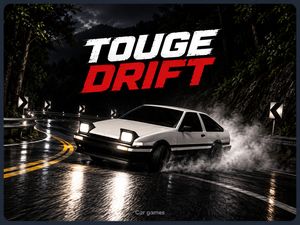
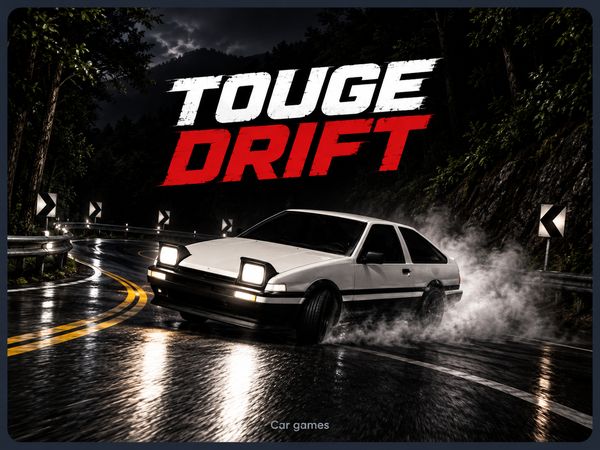
Touge Drift turns mountain driving into a fight against momentum, grip, and every tightening corner. Its strongest hook is the downhill drift: you balance the car through foggy switchbacks while chasing a clean line on narrow mountain passes.
This drift racing simulator runs directly in the browser through Unity WebGL. Volodymyr Bozhko built it around mountain-pass driving physics and detailed vehicle tuning. The single-player format keeps your attention on the road, your setup, and each correction behind the wheel.
Use keyboard controls, test your balance, and learn when to sacrifice speed for control. Play Touge Drift online here and start with a careful run before chasing faster entries.
Core Handling and Touge Drift Physics
Weight Transfer and Entry Speeds
Downhill corners punish rushed inputs. Gravity keeps the car moving, so every steering change arrives with extra weight behind it. Enter each bend with a speed that leaves room for correction.
Use W or Arrow Up to accelerate. Use S or Arrow Down to brake or reverse. The best entry usually comes from easing off before the corner, not braking late while the front points toward the outside edge.
Steer left with A or Arrow Left. Steer right with D or Arrow Right. Make small counter-steering movements once the rear begins to rotate. A sharp opposite input can stop the slide, but it can also pull the car away from the exit.
Watch the road shape, not only the next apex. A downhill turn often leads straight into another direction change. Keep the first slide modest when the following bend looks tighter. That approach protects your exit speed and gives the car space to settle before the next transition.
Think of weight transfer as a timing tool. Brake before the turn, guide the nose inward, then add power as the road opens. If the car feels loose, reduce throttle briefly and counter-steer smoothly. Do not chase a long drift when a short, controlled rotation gives a cleaner line.
Handbrake Initiation on Tight Hairpins
Hairpins need a different entry. Press the Spacebar to use the handbrake or e-brake, then steer toward the turn. This breaks rear traction and helps rotate the car through a tight switchback.
Use the e-brake briefly. Holding it too long removes speed and leaves the car pointed badly for the exit. Release it once the nose faces down the next section, then counter-steer and return to measured throttle. Practice the timing on slower approaches first.
Upgrading Vehicles in Touge Drift
Suspension and Steering Adjustments
The garage gives you four useful areas to shape: suspension, braking style, steering angle, and steering sensibility. Treat each adjustment as a handling choice. Change one area, then drive the same type of corner again.
Start with suspension when the car feels unsettled through downhill bends. A setup that feels too lively can make corrections harder. A calmer response helps you hold a line, especially when the road changes direction quickly. Keep the change small, because a familiar car teaches you more than a completely different one.
Braking style changes how you prepare for entry. Test it before judging the rest of the tune. You want braking that lets you slow before the corner without forcing a sudden correction near the apex. Hairpins reveal weak braking choices quickly, since they demand both speed control and rotation.
Steering angle affects how much direction the car gains from each input. A larger angle can help on very tight turns, but it may feel difficult during quick transitions. A smaller angle can feel calmer when you need smooth changes between left and right bends.
Steering sensibility controls how responsive those inputs feel. Raise it if the car reacts too slowly on tight mountain transitions. Lower it if small key presses create sharp, nervous movements. Look for a setting that lets you correct the slide without fighting the keyboard.
Do not tune every setting at once. Make a suspension change, run a familiar downhill section, and note the result. Then test braking style, steering angle, and sensibility separately. This gives each adjustment a clear job and keeps your garage decisions easy to understand.
A good setup should match your hands. If you prefer gentle corrections, choose a calmer steering response. If you catch slides late, a more responsive setting may help you react sooner. The fastest tune is not universal; it is the one you can control repeatedly.
Starter Garage Strategy and Vehicle Selection
Managing the Starter AE86
The AE86 gives you a clear starting point for learning Touge Drift. Use it to build habits before chasing perfect downhill runs. Its value comes from repetition: the same car makes changes easier to feel.
Begin with a familiar road section. Approach one corner with light braking, then repeat it with a different entry speed. Notice where the car starts to rotate and how much counter-steering keeps the exit clean. Small tests teach more than random runs across the whole mountain.
Use the AE86 to learn each control without rushing. W and Arrow Up add acceleration. S and Arrow Down brake or reverse. AN and Arrow Left steer left, while D and Arrow Right steer right. The Spacebar starts the handbrake rotation when a hairpin demands it.
Keep your early setup changes easy to track. Adjust one garage option, then return to the same corner. If the car becomes harder to place, undo that change. A steady baseline helps you tell driving mistakes from tuning problems.
Investing Your Starting Funds
Touge Drift gives you a $35,000 starting balance for parts and vehicle investment. Spend it with a test plan. Use money on a change that addresses a clear problem, such as nervous steering or weak corner preparation.
Saving some funds also keeps later vehicle choices open. Do not spend everything before you know your preferred handling style. Drive first, tune second, and let repeated mistakes guide the next purchase.
Ready for another run? Start Touge Drift here and put one focused setup change to the test.
Mastering Mountain Downhills and Technical Turns
Tackling Foggy Serpentines
Foggy downhill switchbacks reduce your visual margin. Read the road early and slow before the turn hides its exit. A safe entry gives you time to react when the next bend appears through the haze.
Use the road’s rhythm to plan ahead. After a left turn, expect your hands to prepare for the next right transition. Avoid drifting so wide that the next corner becomes an emergency. Leave space for the car to straighten, then guide it into the following bend.
Serpentines reward patience more than constant throttle. Brake before the tightest section, rotate the car with controlled steering, and add power only when the exit opens. Save the Spacebar for genuine hairpins instead of using it on every corner.
Fog also makes consistency valuable. Focus on clean lines rather than dramatic slides. When a run feels stable, increase entry speed in small steps. One small gain is safer than turning an entire downhill section into a recovery attempt.
Racing Versus Drifting Disciplines
Fast racing lines and stylish drifts need different priorities. Racing favors a tidy entry and strong exit speed. Drifting asks you to manage rear traction while keeping the car aimed down the mountain.
Choose control first on technical turns. A short rotation can beat a long slide if it preserves momentum. Use the handbrake only when the corner needs extra rotation, then return to throttle smoothly.
Fine-Tuning Controls for Touge Drift Performance
Keyboard Precision and Throttle Modulation
Keyboard driving rewards short inputs. Hold W or Arrow Up for acceleration, then ease off before a tight entry. Use S or Arrow Down for braking or reversing when speed drops too late.
Tap A or Arrow Left for left steering. Tap D or Arrow Right for right steering. Avoid holding a direction through the entire bend. Release and correct as the car changes angle.
The Spacebar activates the handbrake or e-brake. Use it to break rear traction on hairpins, not as a replacement for braking. After the car rotates, counter-steer and feed throttle back in carefully.
Throttle modulation matters most near the exit. Full power can widen the line before the car points downhill. Light, repeated acceleration keeps the vehicle settled and lets you correct without losing the whole corner.
Counter-Steering Sensitivity Settings
Steering sensibility changes how quickly the car responds to keyboard inputs. Raise it when tight transitions feel slow. Lower it when counter-steering feels too sharp. Test each setting on the same switchback, then keep the value that makes small corrections predictable.
Compare with Similar Games
| Game |
Why Similar |
| Touge |
Both games focus on 3D mountain pass (touge) driving where players drift through hairpin turns using direct manual steering, throttle, and handbrake controls. |
| Drift Hunters |
Both feature 3D car drifting mechanics centered on maintaining slide angles to accumulate drift score points and tune vehicle handling. |
🎯 Fun Facts About Touge Drift
- The word touge originates from Japanese mountain terminology, representing passes where street drifters historically perfected their craft.
✨ Key Features of Touge Drift
- Authentic touge mountain pass stages featuring foggy downhill switchbacks
- $35,000 starting balance for immediate parts and vehicle investment
- Detailed garage customization for suspension, braking style, steering angle, and sensibility
How to Play Touge Drift
Step 1: Use the game controls
Use W Key to accelerate. Use Arrow Up to accelerate. Use A Key to steer left. Use Arrow Left to steer left.
Step 2: Launch Onto the Mountain Road
Accelerate down the mountain pass using the W key or Up Arrow while observing oncoming switchbacks.
Step 3: Counter-Steer and Exit Smoothly
Steer into the slide direction and feather throttle keys to stabilize the car and power out of the turn.
Touge Drift FAQs
Can I play Touge Drift on mobile devices?
Touge Drift opens in a phone browser, but it is played with the keyboard, so a computer works best.
What are the basic controls for Touge Drift?
Browser keyboard: W Key — accelerate; Arrow Up — accelerate; A Key — steer left; Arrow Left — steer left; D Key — steer right; Arrow Right — steer right; S Key — brake/reverse; Arrow Down — brake/reverse; Spacebar — handbrake/e-brake.
Do I need to download Touge Drift?
No. Touge Drift runs in your browser on this page, with nothing to download or install.
Conclusion
Touge Drift is a focused drift racing simulator that delivers a satisfying single-player driving experience directly in your browser. Built with Unity WebGL by Volodymyr Bozhko, it keeps the action centered on responsive acceleration, steering, braking, and handbrake control. The straightforward design makes it easy to understand while leaving room to enjoy the challenge of handling each turn.
With accessible controls and a clear driving focus, Touge Drift is an enjoyable way to practice your technique. Start the engine and play Touge Drift right here on this page.

No comments yet. Be the first to share your thoughts!